
What Is Kling O1? The Unified Multimodal Revolution Changing AI Video Creation
Discover what is Kling O1 — Kuaishou’s groundbreaking unified multimodal AI video model combining text, image, and video into one seamless creative engine. Learn how Kling O1 redefines content production for film, media, and advertising.
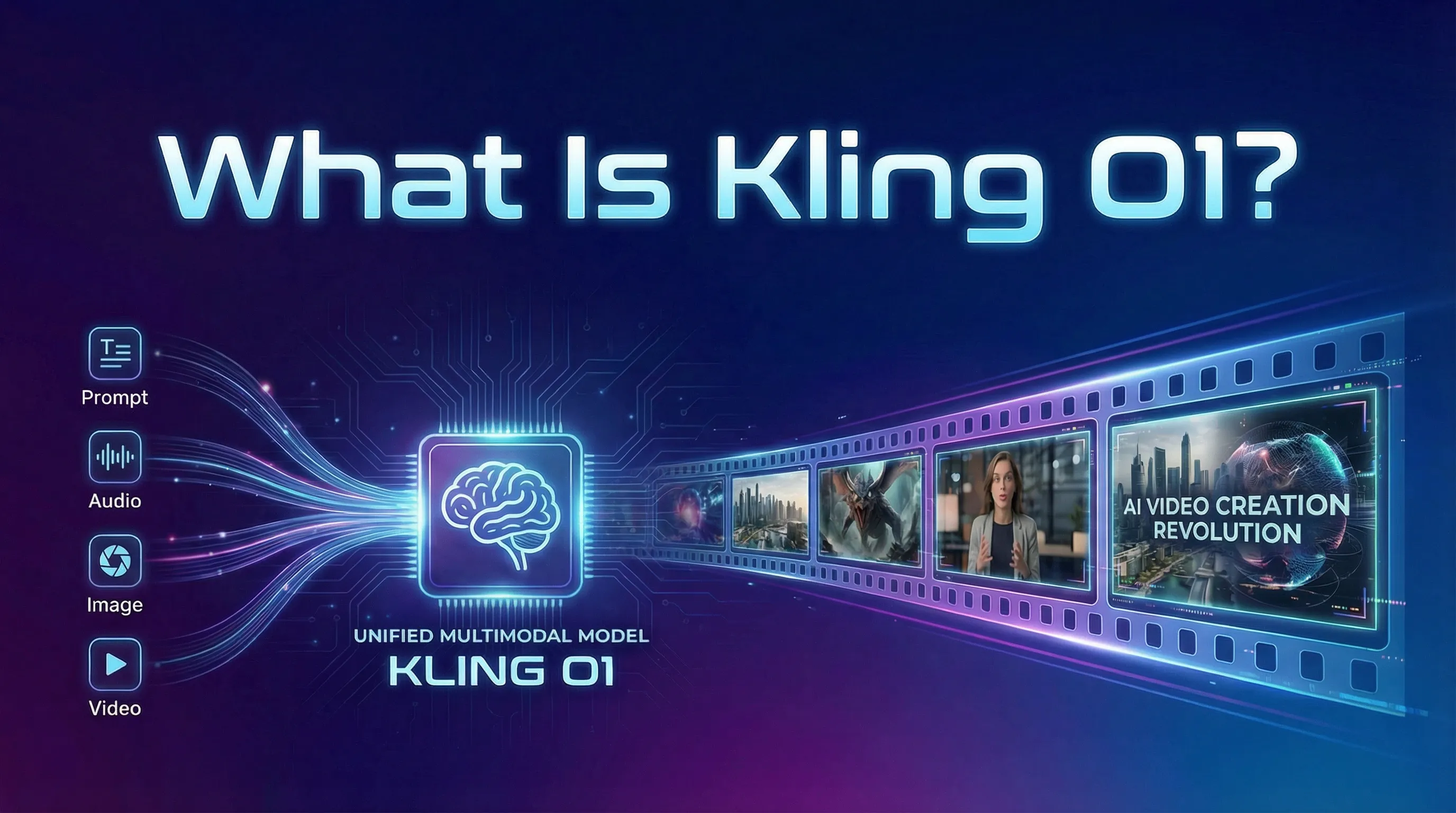
If you’ve been following the evolution of AI video generation, you’ve probably seen one name dominating discussions lately: Kling O1. But what is Kling O1, and why is everyone calling it a milestone moment for creative technology?
Launched by Kling AI, under Kuaishou Technology, on December 1, 2025, Kling O1 stands as the world’s first unified multimodal video model — a next-generation system that completely redefines how creators produce, edit, and control visual content.
This isn’t just another AI video generator. Kling O1 is engineered from the ground up to combine all creative processes — from text-to-video generation to deep editing — within one consistent, intelligent engine. Let’s unpack what makes Kling O1 revolutionary, and how it changes the rules for AI-powered storytelling.
🎬 What Is Kling O1? The Core of a Creative Revolution
To understand what is Kling O1, imagine a tool that merges every step of filmmaking and editing into one fluent process.
Unlike older models that specialize in one area (for example, only generating video or only editing images), Kling O1 unifies everything. It processes text, images, videos, and subjects directly as prompts, running them through a singular multimodal logic system.
Built upon a newly introduced Multimodal Visual Language (MVL) framework, Kling O1 doesn’t just interpret your words — it understands context, continuity, and visual relationships. This means creators can prompt the model with instructions like:
“Turn the scene from day to night,”
“Replace the main character with the same actor wearing new clothes,” or
“Extend the shot five more seconds.”
…and Kling O1 executes all those transformations in a single, seamless motion.
When people ask “What is Kling O1?”, the answer is simple but powerful: it’s the first system where all parts of AI filmmaking speak the same language.
🧠 The Unified Engine: Multimodal Intelligence in Motion
So, what is Kling O1’s real breakthrough under the hood?
At its heart lies the Multimodal Visual Language Engine (MVL) — a transformer‑based network that connects motion, objects, scenes, lighting, and dialogue context into a continuous logical space.
While traditional systems switch between modules for generation, modification, or rendering, Kling O1 performs everything in-stream, maintaining pixel-level accuracy across edits.
According to internal reports shared during the Hong Kong launch, the MVL engine allows Kling O1 to reduce inconsistent frame errors by 78% compared to Kling 1.6, while improving subject identity retention by 92% in multi‑scene videos.
This means characters no longer “shapeshift” between cuts — a long-standing flaw in AI film generation that Kling O1 solves decisively.
🎨 What Is Kling O1 Doing for Creativity?
Kling O1 doesn’t just generate video; it thinks like a director with “visual memory.”
It remembers each subject — their expressions, clothing, and silhouettes — even after camera shifts or
lighting changes.
Picture this: You upload three reference images of an actor and type,
“Create a beachside fashion shoot at sunset, same character, flowing scarf.”
Kling O1 preserves the actor’s identity, renders fabric texture under the orange light, and even matches the motion to background wind physics — all automatically.
That’s why asking “What is Kling O1 for?” often leads to the same answer: it’s designed for creative control and continuity. Film producers, advertisers, and designers no longer need multiple AI models for each task — Kling O1 is one studio in a single engine.
🔄 Seamless Editing Without Manual Work
One major frustration for video makers has always been how tedious post‑production can be. Kling O1 fixes that completely.
Instead of using complex timelines or masking tools, users can simply instruct Kling O1 conversationally. For instance:
- “Remove passersby from the background.”
- “Turn the lighting mood from warm to cool.”
- “Swap the car model with a blue sports version.”
And Kling O1 immediately performs these edits through pixel‑level semantic reconstruction — no keyframes, no manual selection, just precision edits guided by prompts.
That level of simplicity is why Kling O1 is now seen as an AI editor for everyone, not just professionals.
📺 Industrial‑Grade Consistency for Media and Advertising
In advertising, where continuity and realism are non‑negotiable, Kling O1 proves its worth.
Marketing agencies can upload product photos or brand imagery, type a few descriptive lines, and
generate complete product demo videos in minutes.
Early results show that brands using Kling O1’s commercial preview version were able to reduce production time by over 65% while cutting visual effect costs by half.
That’s the business reason why “What is Kling O1?” isn’t just a tech question — it’s now a marketing and logistics answer.
Fashion studios can even create virtual runway clips 24/7 by uploading clothing images. Kling O1 automatically retains design textures, adjusts lighting angles, and builds new high‑resolution short videos that look like live shoots.
🧩 Skill Combos: Hybrid Creations Made Simple
One of the most exciting capabilities of Kling O1 is what Kuaishou calls “Skill Combos.”
This means users aren’t limited to one creative command per prompt. Kling O1 can:
- Insert a subject while transforming the environment.
- Shift artistic style while extending a scene.
- Modify a character’s pose while retaining all other visual elements.
With this multi‑task fusion, creators can achieve complex, layered storytelling — the kind that once took entire VFX teams — in one pipeline. This is the true definition of what Kling O1 makes possible.
⏱️ Total Temporal Control
Kling O1 now gives users precise control over video duration — from quick 3‑second clips perfect for social media to 10‑second sequences suitable for storytelling or ads.
Future updates are set to expand these limits further with first‑ and last‑frame independence, giving editors even finer control over pacing and transitions.
That means, whether you’re producing a cinematic teaser or a short‑form brand burst, Kling O1 adapts to your creative rhythm.
🌍 Where You Can Try Kling O1 Now
If you’re curious to experience firsthand what Kling O1 can do, you can explore it exclusively
through MixHub AI, which provides early access to Kling’s unified generation system.
👉 Try Kling O1 on MixHub AI

Through MixHub’s interface, you can test‑drive Kling O1’s text‑to‑video, image‑to‑video, and hybrid subject‑editing modes — the full suite that defines this next‑generation model.
🚀 Why Kling O1 Marks a Turning Point
When people ask “What is Kling O1?”, they’re really asking “What’s next for AI video?”
And Kling O1’s launch answers that. By merging generation, comprehension, and editing into one model,
Kling AI has effectively ended the fragmentation era of visual content tools.
It’s not just a product; it’s a signal — that from now on, AI creativity will be unified, consistent,
and intuitive.
So the next time you find yourself wondering “What is Kling O1?”, remember this:
It’s not just a model — it’s a multimodal creative partner, closing the gap between imagination and
final cut.
The filmmaking future is no longer about separate tools.
It’s about one model that does it all — Kling O1.